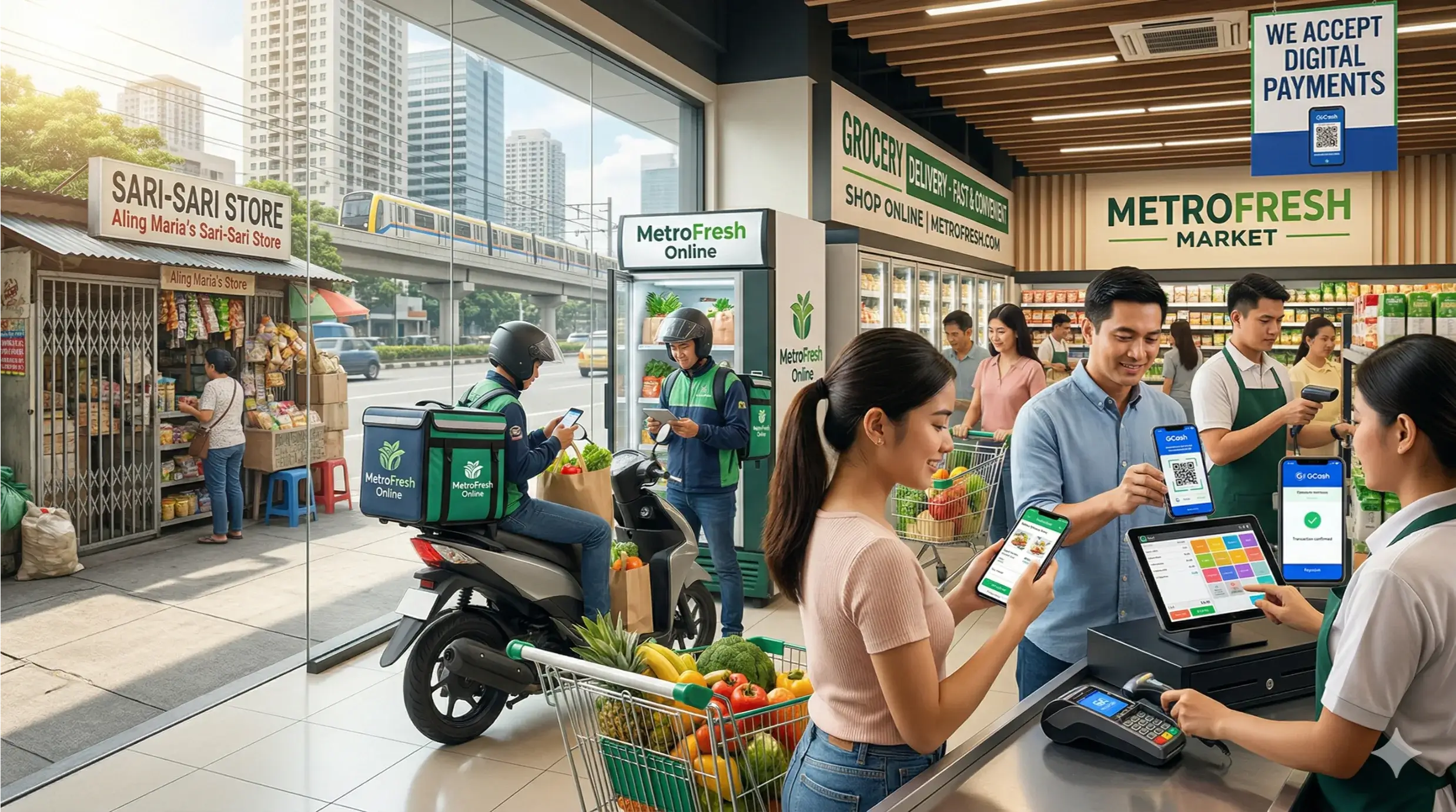
The Philippines grocery retail sector is expanding rapidly as rising incomes, urbanization, and digital adoption reshape how consumers shop. From modern supermarkets in Metro Manila to neighborhood sari-sari stores across provincial regions, retailers are adapting to a more connected, convenience-driven market.
Technology is now a core competitive advantage. Retailers are investing in cloud-based systems, digital payments, and real-time inventory tools to manage operations more efficiently and meet evolving customer expectations.
This article explores the latest verified data on market size, growth drivers, consumer trends, challenges, and the role of cloud POS technology in helping grocery retailers succeed.
The Philippines food and grocery retail market reached USD 55.2 billion in 2025 and is projected to grow to USD 71.6 billion by 2034, representing a compound annual growth rate of 2.95%.
Growth is being driven by:
These structural changes are reshaping how grocery businesses operate and compete.
Retail demand is also supported by strong domestic consumption. Household spending accounts for nearly 70% of national GDP, creating a stable base for retail growth.
Urbanization continues to increase demand for modern retail formats such as supermarkets, hypermarkets, and convenience stores.
A growing middle class with higher purchasing power is one of the most important drivers of grocery retail growth.
Retailers are expanding into secondary cities and provincial markets to capture new demand.
Digital transformation is accelerating across the grocery sector.
Key verified trends include:
These shifts are changing how retailers manage inventory, payments, and customer engagement.
The online grocery segment is expanding significantly.
The Philippines online grocery market:
This rapid growth is driven by:

The grocery retail market is highly competitive and dominated by several large national chains.
Leading players include:
These companies dominate the market through large store networks, logistics infrastructure, and strong brand recognition.
For example:
Puregold holds approximately 16% to 18% market share in the grocery segment, highlighting the concentration of market power among large chains.
At the same time, smaller retailers and discount formats continue to expand, particularly in provincial regions.
Busy urban households are prioritizing speed and convenience when shopping for groceries.
Retailers are responding with:
Convenience-focused shopping is becoming a major competitive factor.
Consumers are increasingly choosing:
Retailers are adapting by expanding product selection and improving supply transparency.
Growth is no longer limited to Metro Manila.
Recent industry analysis shows:
Mindanao is currently one of the fastest-growing retail regions in the country, with strong increases in both sales volume and value.
This shift is encouraging retailers to expand into underserved markets.
Despite strong growth, grocery retailers face several operational challenges.
Infrastructure limitations remain a major issue.
Common challenges include:
These factors increase operating costs and reduce product availability in rural areas.
Retailers are experiencing pressure from:
This is especially challenging for small and mid-sized grocery businesses competing against large chains.
Grocery retailers manage thousands of products across:
Managing stock manually increases the risk of:
Technology is becoming essential to address these challenges.
Modern grocery businesses rely on real-time data and automation to operate efficiently.
Cloud-based point-of-sale systems provide the tools needed to manage daily operations, reduce errors, and improve customer service.
Cloud POS systems provide live visibility into stock levels.
Key benefits:
Accurate inventory control is one of the most important factors in grocery profitability.
Retailers operating multiple locations need centralized control.
Cloud POS enables:
This is especially valuable for growing grocery chains.
Digital payments are becoming the standard in retail.
Cloud POS systems support:
This improves customer experience and reduces checkout time.
Retailers now sell through multiple channels, including:
Cloud POS integrates all sales channels into one system, improving reporting accuracy and operational efficiency.

Retailers are investing in digital systems because consumer expectations are changing rapidly.
Technology adoption is being driven by:
Retail modernization is no longer optional. It is a business requirement.
The long-term outlook for the sector remains strong.
Key projections:
Retail sales are expected to grow steadily as population size, income levels, and urbanization continue to increase.
The Philippines grocery retail market in 2025–2026 is defined by rapid transformation.
Rising incomes, digital adoption, and changing consumer behavior are reshaping the industry. Retailers are expanding into new regions, adopting online sales channels, and investing in technology to improve efficiency.
Cloud-based point-of-sale systems play a central role in this transformation. They provide real-time visibility, operational control, and the flexibility needed to compete in a fast-changing retail environment.
For grocery retailers, the future will depend on how effectively they combine operational efficiency with digital capability.
The growth of grocery retail in the Philippines is driven by rising household incomes, increasing smartphone usage, urbanization, and the rapid adoption of digital payments. Consumers are shopping more frequently online and expecting faster delivery, convenient payment options, and better product availability. As a result, retailers are investing in technology to improve efficiency and customer experience.
The online grocery market in the Philippines is expanding at one of the fastest rates globally. It generated approximately USD 3.9 billion in 2025 and is projected to reach USD 32.3 billion by 2034, with a compound annual growth rate (CAGR) of over 26%. This growth is fueled by mobile-first consumers, digital wallet adoption, and the expansion of delivery platforms.
A cloud POS system helps grocery retailers manage daily operations more efficiently. It provides real-time visibility into sales and inventory, supports digital payments, and allows business owners to monitor performance from anywhere. In a competitive market where customers expect speed and accuracy, cloud POS technology helps retailers reduce errors, prevent stockouts, and improve customer service.
Yes. Cloud POS systems are designed for businesses of all sizes, including small convenience stores and neighborhood groceries. They do not require expensive hardware and can run on smartphones or tablets. This makes them affordable for small retailers while still offering advanced features such as inventory tracking, sales reporting, and employee management.
Cloud POS systems automatically track stock levels in real time. They can alert store owners when items are running low, monitor product expiry dates, and generate purchase order suggestions. This helps reduce waste, prevent stock shortages, and ensure popular products are always available for customers.
Grocery stores should support multiple payment methods to meet customer expectations. These typically include digital wallets, QR code payments, credit and debit cards, and cash. With a growing percentage of consumers preferring digital payments, offering flexible payment options helps increase sales and improve customer satisfaction.
Yes. Multi-store management is a core feature of modern cloud POS systems. Retailers can monitor sales performance across branches, transfer inventory between locations, and manage staff from a single dashboard. This is especially useful for supermarket chains and growing grocery businesses.
Cloud POS systems are built to handle both in-store and online orders. They can combine sales from walk-in customers, delivery services, and pickup orders into one reporting system. This gives retailers a complete view of their business and eliminates the need to manually reconcile different sales channels.
Common challenges include inventory shortages, rising operating costs, staff turnover, and increasing customer expectations for fast service and digital payments. Competition from online grocery platforms and delivery services is also growing. Technology solutions like cloud POS systems help retailers address these challenges by improving efficiency and visibility.
Most cloud POS systems can be set up within a few hours. Retailers can download the software on a smartphone, tablet, or computer and start processing sales immediately. Additional features such as inventory management and reporting can be configured as the business grows.